
Maladaptive daydreaming · 04
The MDS-16 scale
The Maladaptive Daydreaming Scale: a 16-question form you can fill in yourself. The original English form and its translations in 24 languages are on this page.
The MDS-16 (16-item Maladaptive Daydreaming Scale) was developed by Eli Somer, Jayne Bigelsen, Jonathan Lehrfeld and Daniela Jopp. It asks about your daydreaming over the past month: the place of music in it, the urge to return to a daydream, how daydreaming relates to everyday tasks and goals, and the movements that come with it.
The scale has been translated into more than 40 languages. The forms here are the versions shared by the research group that developed the scale, as validated measurement tools. In each language, that language’s form is used word for word. The MDS-16 is open access: it is free to use for personal, clinical and research purposes.
The original form
The 16-item Maladaptive Daydreaming Scale (MDS-16)
Eli Somer, Jayne Bigelsen, Jonathan Lehrfeld and Daniela Jopp. The cut-off score discussed below refers to this English form.
16 questions, a few minutes. Your score is calculated in your browser; your answers are not sent anywhere. · PDF · 3 pages · 45 KB
How to fill it in
- Think of the past month. Let your answers be about the last month.
- For each question, mark the one of eleven steps from 0% to 100% that fits you best.
- The score is the average of the 16 answers: add up the percentages you marked and divide by 16. The result is a number from 0 to 100.
The example question on the form
Some people get so caught up in their daydreaming that they forget where they are. How often do you forget where you are when you daydream?
What does the score tell you?
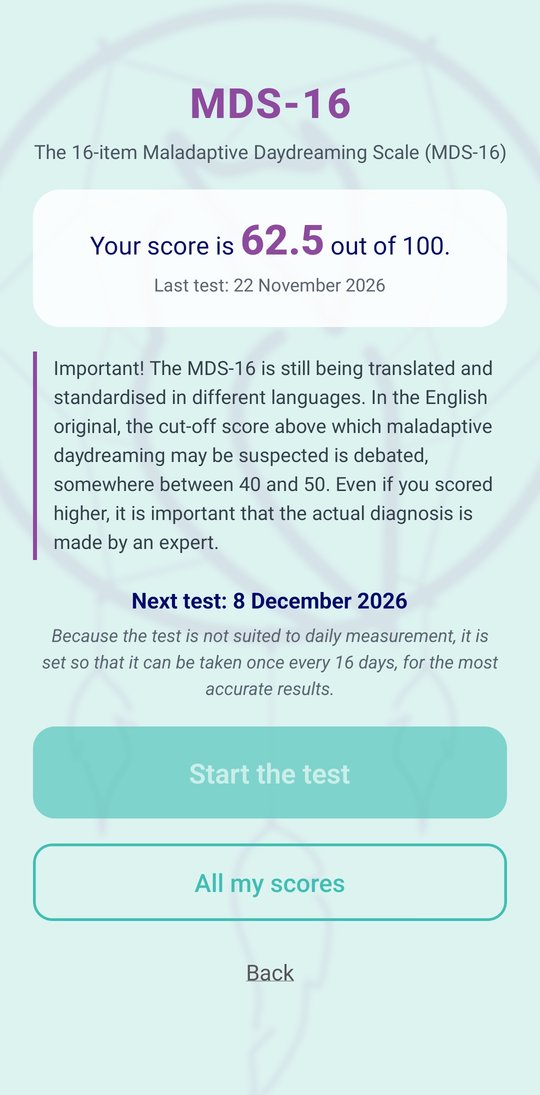
The MDS-16 is still being translated and standardised in different languages. In the English original, the cut-off score above which maladaptive daydreaming may be suspected is debated, somewhere between 40 and 50. Even if you scored higher, it is important that the actual diagnosis is made by an expert.
 Coming in 2027
It’s in the app too
In the DayDream Diary app, the MDS-16 is a button on the Real Life screen, next to the reports. You fill in the scale on your phone, in the form for the app’s language, and your score is calculated straight away.
- Once every 16 days. Because the test is not suited to daily measurement, it is set this way for the most accurate results. When the time comes, the button glows.
- All my scores. The scores of all your tests, in date order, on a chart and in a list.
- Part of the report. The DayDream Diary Report includes a recent MDS-16 result alongside your records.
Other languages
If you think in another language, or would like to share the scale with someone close to you: each language opens the PDF of its own form. Scoring is the same on every form.
- Arabicالعربية
- Bengaliবাংলা
- Chinese (Mandarin)中文
- GermanDeutsch
- GreekΕλληνικά
- Hebrewעברית
- Hindiहिन्दी
- HungarianMagyar
- IndonesianBahasa Indonesia
- ItalianItaliano
- Japanese日本語
- Korean한국어
- KyrgyzКыргызча
- MacedonianМакедонски
- NorwegianNorsk
- PolishPolski
- PortuguesePortuguês
- RussianРусский
- SerbianSrpski
- SpanishEspañol
- SwedishSvenska
- TurkishTürkçe
- UkrainianУкраїнська
- VietnameseTiếng Việt
The forms as shared by the research group that developed the scale: daydreamresearch.wixsite.com/md-research/measures
References
The scale and the cut-off score
Somer, E., Lehrfeld, J., Jopp, D. S., & Bigelsen, J. (2016). Development and validation of the Maladaptive Daydreaming Scale (MDS). Consciousness and Cognition, 39, 77–91. https://doi.org/10.1016/j.concog.2015.12.001
Somer, E., Soffer-Dudek, N., Ross, C. A., & Halpern, N. (2017). Maladaptive daydreaming: Proposed diagnostic criteria and their assessment with a structured clinical interview. Psychology of Consciousness: Theory, Research, and Practice, 4(2), 176–189. https://doi.org/10.1037/cns0000114
Soffer-Dudek, N. (2025). Corrigendum for “Maladaptive daydreaming: Proposed diagnostic criteria and their assessment with a structured clinical interview” concerning the cutoff of the Maladaptive Daydreaming Scale (MDS-16). Psychology of Consciousness: Theory, Research, and Practice. https://doi.org/10.1037/cns0000433
Soffer-Dudek, N., Somer, E., Abu-Rayya, H. M., Metin, B., & Schimmenti, A. (2020). Different cultures, similar daydream addiction? An examination of the cross-cultural measurement equivalence of the Maladaptive Daydreaming Scale. Journal of Behavioral Addictions.
Validation studies in other languages
Arabic · Abu-Rayya, H. M., Somer, E., & Meari-Amir, S. (2019). The psychometric properties of the Arabic 16-item Maladaptive Daydreaming Scale (MDS-16-AR) in a multicountry Arab sample. Psychology of Consciousness: Theory, Research, and Practice. https://doi.org/10.1037/cns0000183
Hebrew · Jopp, D. S., Dupuis, M., Somer, E., Hagani, N., & Herscu, O. (2018). Validation of the Hebrew version of the Maladaptive Daydreaming Scale (MDS-H): Evidence for a generalizable measure of pathological daydreaming. Psychology of Consciousness: Theory, Research, and Practice. https://doi.org/10.1037/cns0000162
Hungarian · Sándor, A., Münnich, Á., & Molnár, J. (2020). Psychometric properties of the Maladaptive Daydreaming Scale in a sample of Hungarian daydreaming-prone individuals. Journal of Behavioral Addictions.
Indonesian · Kaifa, A. F., Jatnika, R., & Wardhani, N. (2026). Adaptation and psychometric evaluation of the Indonesian Maladaptive Daydreaming Scale-16 (MDS-16-Ina). Acta Psychologica, 264, 106139. https://doi.org/10.1016/j.actpsy.2025.106139
Italian · Schimmenti, A., Sideli, L., La Marca, L., Gori, A., & Terrone, G. (2019). Reliability, validity, and factor structure of the Maladaptive Daydreaming Scale (MDS–16) in an Italian sample. Journal of Personality Assessment. https://doi.org/10.1080/00223891.2019.1594240
Polish · Pietkiewicz, I. J., Hełka, A., Barłóg, M., & Tomalski, R. (2023). Validity and reliability of the Polish Maladaptive Daydreaming Scale (PMDS-16) and its short form (PMDS-5). Clinical Psychology & Psychotherapy. https://doi.org/10.1002/cpp.2844
Turkish · Metin, S., Göçmen, B., & Metin, B. (2022). Turkish validity and reliability study of maladaptive daydreaming. Psychiatry and Behavioral Sciences, 12(1), 1–6. https://doi.org/10.5455/PBS.20210907111754
Turkish · Karabulut, S., Başer Özkoç, B., Tosun, O., & Karabulut, A. (2026). Psychometric properties of the Turkish maladaptive daydreaming scale-16 in a psychiatric clinical sample enriched with dissociative disorders. European Journal of Trauma & Dissociation, 10(3), 100732. https://doi.org/10.1016/j.ejtd.2026.100732
Ukrainian · Balashevich, O. K., Harahukiua, A. I., Molotokas, A. A., Bayer, O. O., & Kurapov, A. O. (2024). Adaptation and psychometric evaluation of the Maladaptive Daydreaming Scale (MDS-16) on a Ukrainian sample: A pilot study. Perspectives and Innovations of Science, 6(40), 609–629. https://doi.org/10.52058/2786-4952-2024-6(40)-609-629
Vietnamese · Pham, Q. D., Nguyen, N. K., & Pham, T. D. (2026). Assessing the psychometric properties of the Maladaptive Daydreaming Scale 16 (MDS-16) in a Vietnamese student sample: A network analysis approach. Counselling Psychology Quarterly, 1–22. https://doi.org/10.1080/09515070.2026.2687577